
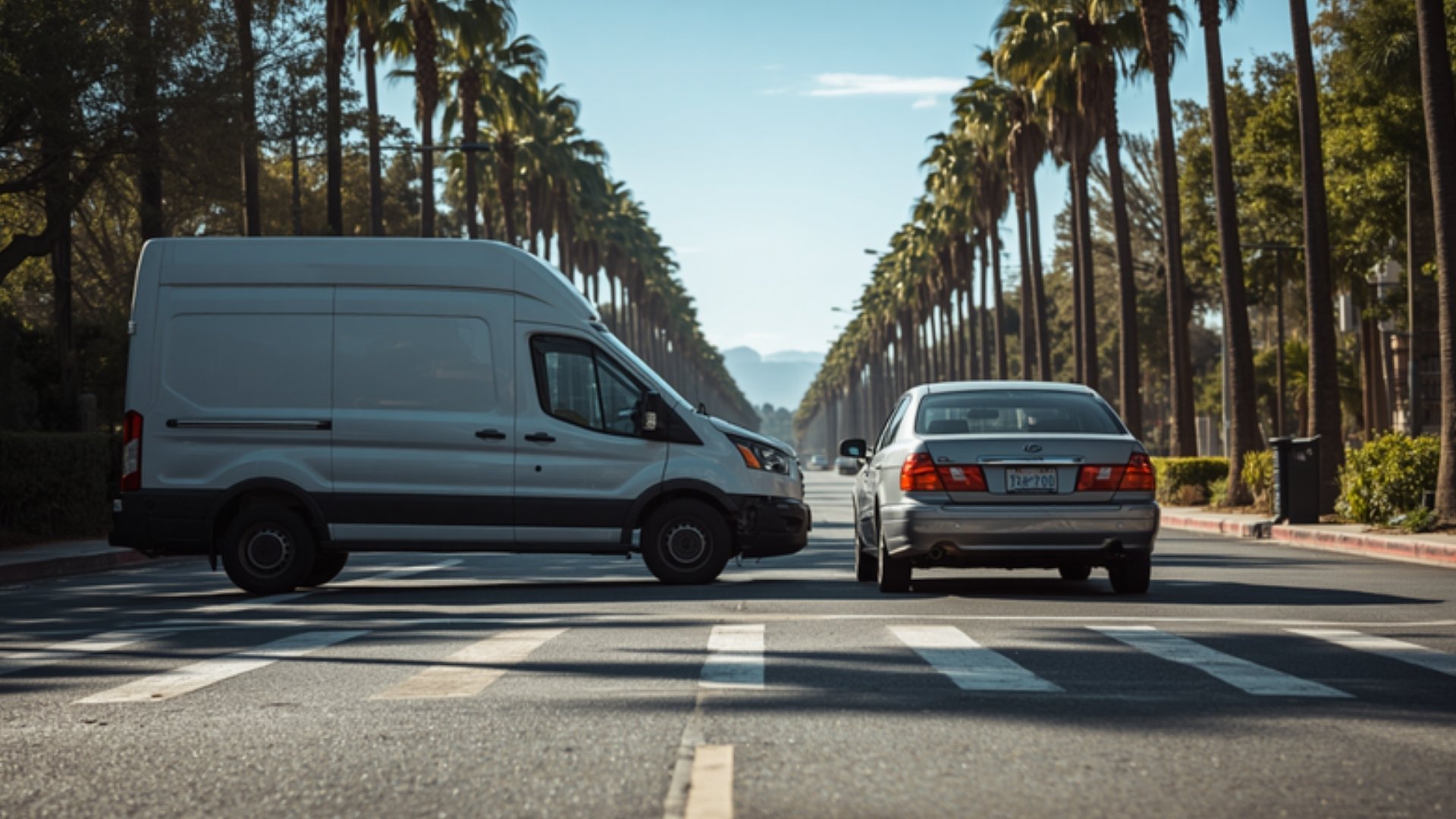
If the driver who hit you was working, the employer usually pays for the harm. A Los Angeles car accident lawyer proves the driver was on the job and finds the company or agency policy. When a city, county, or Metro vehicle caused the crash, the lawyer files a government claim within six months.
Robert Hindin & Associates represents injured people across California from its West Los Angeles office on Olympic Boulevard. Robert Hindin has been admitted to the California Bar since 1975. Kyle Hindin joined the bar in 2016 and has represented only injured clients since. The firm never works for insurers or defendants.
If a delivery van, company truck, or city vehicle hit you in Los Angeles, call Robert Hindin & Associates at (310) 473-0337 for a free case review. You pay no legal fees unless the firm wins.
Why It Matters That the Driver Was Working When the Crash Happened
A crash with a working driver is a different claim from a crash with a commuter in a personal car. The Los Angeles car accident lawyers at Robert Hindin & Associates look at the employer first. The reason is simple. An employer usually has more insurance than the person behind the wheel.
Los Angeles streets carry a steady flow of work vehicles. Plumbing vans, parcel trucks, and landscaping crews share Wilshire Boulevard and Olympic Boulevard with commuters. City sanitation trucks and Metro buses run the same routes every day. Each one has an employer behind it, and that employer can often be held responsible for the driver’s mistake.
Respondeat Superior Under California Law
The legal term is respondeat superior. It means the employer answers for an employee’s negligence on the job. California Civil Code section 2338 makes a principal responsible to third persons for an agent’s negligence in the transaction of the business. You do not have to prove the company did anything wrong itself. You have to prove its employee was careless while doing the company’s work.
Owner Liability Has a Cap That Employer Liability Does Not
Vehicle Code section 17150 makes a vehicle owner liable when someone drives the car with permission. Section 17151 caps that owner liability at $15,000 for one injured person and $30,000 per accident. The same section says the cap does not apply when liability arises from an employer and employee relationship. That difference matters a great deal in a serious injury case.
Why the Cap Can Leave a Serious Claim Short
A driver’s personal policy may carry only the state minimum. Vehicle Code section 16056 sets that minimum at $30,000 per person for policies issued or renewed on or after January 1, 2025. Older policies still in force may carry only $15,000. A spinal injury or a surgery can pass those numbers within days of the crash.
What a Business Policy Changes
Businesses that put employees on the road often carry commercial auto coverage. Many also carry umbrella or excess policies above it. Those limits are usually far higher than a personal policy. Proving the driver was working is how you reach that coverage instead of stopping at the driver’s own limit.
How a Los Angeles Car Accident Lawyer Proves the Driver Was on the Clock
The employer’s insurer will almost always argue that the driver was off duty. Maybe the driver was on a lunch break. Maybe the driver was heading home or running a personal errand. Each of these arguments has a legal answer, and the answer depends on facts that have to be gathered early.
A Los Angeles car accident lawyer builds that record before it disappears. Delivery routes, dispatch notes, and phone data are all kept for limited periods. The California car accident attorneys at the firm send preservation letters, so the company has written notice not to delete them.
The Scope of Employment Test
The question is whether the driver was acting within the scope of employment. California juries decide it under the Judicial Council civil jury instructions. The test is broader than most people expect, and it often surprises drivers. A driver does not need to be making a delivery at the moment of impact. The conduct only has to be connected closely enough to the job.
Errands and Minor Detours
Drivers mix personal errands with work trips all the time. CACI No. 3723 tells jurors that combining personal business with the employer’s business stays within the scope of employment. The exception is a substantial deviation. Minor delays, incidental personal acts, and a detour from the most direct route are treated as expected parts of the job.
Commutes and the Going and Coming Rule
An ordinary commute usually falls outside the job. California courts call this the going and coming rule, and they trace it through Hinman v. Westinghouse Electric Co. (1970) 2 Cal.3d 956. Hinman also recognized exceptions when the trip gives the employer a benefit not shared by ordinary commuters. Those exceptions decide many Los Angeles cases.
The Required Vehicle Exception
Some employers require workers to drive their own cars to work. The point is to keep the car available for business. Under CACI No. 3725, the commute then falls within the scope of employment. Moradi v. Marsh USA, Inc. (2013) 219 Cal.App.4th 886 applied this rule to an employee driving home to Woodland Hills. Her planned stops for frozen yogurt and a yoga class were treated as minor deviations.
The Incidental Benefit Exception
The same instruction covers a second situation. An employee may agree to make a personal vehicle available for work even without a formal rule. If the employer has come to rely on that vehicle, the commute can still count as work. Sales staff, home health workers, and field inspectors often fit this pattern.
Evidence That Shows the Driver Was Working
Proof of employment status comes from records, not from the driver’s word at the scene. Many drivers tell police they were on their way home. The paperwork often says otherwise. Your own notes and photos from the crash scene can start the record before anyone has a chance to change the story. Keep them in one place and share them only with your lawyer.
Logos, Fleet Numbers, and Commercial Plates
Photograph the vehicle from every side before it leaves. A company name on the door, a fleet number on the bumper, or a commercial plate all point to a business owner. Write down any phone number printed on the vehicle as well. These details help identify the correct company when several contractors share one name.
Dispatch Logs, GPS Data, and Delivery Apps
Most fleets track their vehicles by GPS and log each stop. Delivery drivers often scan packages that timestamp their location. A preservation letter asks the company to keep those records. Without one, routine deletion can erase the best proof that the driver was working. Gig drivers raise separate insurance rules covered on our Los Angeles rideshare accident page.
What Changes When a City or County Employee Hit You in Los Angeles
Government drivers are everywhere in this city. City sanitation trucks, county vehicles, and Metro buses cover the same streets daily. A public entity can be held liable for its driver’s negligence, but the claim follows different rules. Missing those rules can end the case before it starts.
Vehicle Code section 17001 makes a public entity liable for injuries caused by an employee’s negligent operation of a vehicle within the scope of employment. Government Code section 815.2 states the same principle for public employees in general. The difference is procedural. You must present a written claim to the agency before you can sue.
The Six-Month Government Claim Deadline
Under Government Code section 911.2, a claim for personal injury must be presented within six months of the crash. The agency then has 45 days to act under Government Code section 912.4. Silence after 45 days counts as a rejection. Once the agency mails a written rejection, Government Code section 945.6 gives you six months to file suit. That second deadline is shorter than the two years most people expect.
When the Six Months Have Already Passed
Government Code section 911.4 allows a written application to present a late claim. The application must be made within a reasonable time, and never more than one year after the crash. It must explain the delay and attach the proposed claim. Agencies do not have to grant it, so this path is a fallback and not a plan.
When Nobody Mails a Rejection Notice
Some agencies never send the written notice described in Government Code section 913. In that case, section 945.6 allows up to two years from the crash to file suit. Relying on that longer window is risky. The safer practice is to treat the six-month suit deadline as the real one.
Where to File Depends on Which Agency Owns the Vehicle
Los Angeles has several public entities operating vehicles on the same streets. Each one has its own claim office. Sending the claim to the wrong agency does not stop the clock. Confirm the owner from the police report and the vehicle markings before filing anything. A city truck and a county truck can look almost identical on the road. The door seal and the fleet number usually tell them apart.
City of Los Angeles Vehicles
Claims against the City go to the Office of the City Clerk. The office sits in City Hall, 200 North Spring Street, Room 395. The City also accepts claims through an online portal that issues a claim number right away. After filing, the City Attorney’s Claims Division takes over the review.
Los Angeles County Vehicles
Claims against the County are addressed to the Executive Officer of the Board of Supervisors, Attention Claims. The office is at 500 West Temple Street, Room 383. The County asks for one claim form per claimant. It accepts the original in person or by United States mail.
LA Metro Buses and Vehicles
Metro is a separate agency from the City and the County. Its Legal Services office takes claims at One Gateway Plaza, mail stop PL4, next to Union Station. Metro accepts claim forms only in person or by mail and rejects email submissions. It tells claimants to allow two to three weeks for a first response.
When You Were Also Working at the Time of the Crash
Sometimes both drivers were on the job. A courier driving for one company collides with a technician driving for another. Your own employer’s workers’ compensation coverage then pays certain benefits. That coverage does not end your claim against the other driver’s employer. It also does not pay for pain and suffering.
Labor Code section 3602 makes workers’ compensation the exclusive remedy against your own employer in most cases. Labor Code section 3852 preserves your right to sue any person other than your employer. The two claims run side by side, and each one has its own rules.
Hit by a Coworker
A crash with a coworker is the hardest version of this problem. Labor Code section 3601 generally limits you to workers’ compensation when the other driver works for your employer. The statute allows a lawsuit against the coworker in two cases. One is a willful and unprovoked act of aggression. The other is intoxication that caused the injury. Outside those two cases, the workers’ compensation system is usually the only path.
Hit by Another Company’s Employee
A driver from a different company is a third party. You can pursue that driver and that driver’s employer for full damages, including pain and suffering. Section 3852 also lets your employer seek repayment of the compensation it paid. Coordinating the two claims is part of the work, and it affects how much reaches you. Settling one claim without the other in mind can cost you money.
Who Writes the Crash Report in Los Angeles and How to Get It
The report usually names the vehicle owner, lists insurance, and records what each driver said. Those statements often show the driver was working. The agency that writes it depends on where the crash happened. The Los Angeles Police Department handles city streets, and the California Highway Patrol handles freeways such as the I-405 and the I-10.
Inside city limits, LAPD’s Traffic Group runs four traffic divisions. They are Central, South, Valley, and West. West Traffic Division works from 4849 Venice Boulevard. It covers the Hollywood, Olympic, Pacific, West Los Angeles, and Wilshire patrol areas.
Requesting an LAPD Collision Report
Under Vehicle Code section 20012, the department must release a report to anyone with a proper interest in it. That includes the drivers, injured people, and their attorneys. The fee is $19, and many reports can be ordered online through LexisNexis. LAPD asks you to allow at least 45 days from the crash date. Payment by mail must be a check or money order, since the department does not take cash.
Reports That Must Be Requested by Mail
Some reports are not available online. These include reports involving an arrest, a fatality, or a juvenile. Reports issued before February 1, 2016, are also mail only. Send those requests to the Records and Identification Division, Document Processing Unit, P.O. Box 30158, Los Angeles, CA 90030. Include the report number, the crash date, and the location. A lawyer can request the report for you and follow up if it is delayed.
Where a Los Angeles Work Vehicle Case Gets Filed
Most injury cases here are filed in the Los Angeles County Superior Court. Code of Civil Procedure section 335.1 gives you two years from the crash to file against a private company. A claim against a public entity follows the shorter government claim timeline first. Commercial defendants often have larger legal teams, so early filing keeps pressure on them.
The court changed how it handles these cases. Effective January 8, 2024, personal injury cases filed in the Central District go to Independent Calendar departments at the Stanley Mosk Courthouse, 111 North Hill Street. The old Personal Injury Hub at the Spring Street Courthouse no longer takes new cases. Guides that still route every case to Spring Street are out of date. More about local practice is on our Los Angeles personal injury page.
Frequently Asked Questions About Crashes With Working Drivers in Los Angeles
These are questions people ask after a crash with a company or government vehicle. The answers are general and cannot replace advice about your own facts. Every case turns on the report, the records, and the insurance. Deadlines against public agencies move quickly, so write down the crash date today.
Can I Sue Both the Driver and the Company?
Yes. The driver is liable for his or her own negligence, and the employer is liable under respondeat superior. Naming both is common, although the employer’s policy usually pays.
What if the Company Says the Driver Is an Independent Contractor?
Employers are generally not liable for a true independent contractor. The label in a contract does not settle the question. Courts look at how much control the company actually had over the work.
Does the Six-Month Deadline Apply if a Private Company Hit Me?
No. The six-month claim rule in Government Code section 911.2 applies to public entities. A crash with a private company’s vehicle follows the two-year rule in Code of Civil Procedure section 335.1.
What if a Company Truck Caused the Crash?
Large commercial trucks raise federal safety rules and different insurance limits. Those cases need a separate analysis. Our Los Angeles truck accident page explains that process.
Will My Own Fault Reduce What I Recover?
It can reduce the amount, but it will not bar the claim. California follows pure comparative negligence under Li v. Yellow Cab Co. (1975) 13 Cal.3d 804. Your damages drop by your share of fault.
Talk to a Los Angeles Car Accident Lawyer at Robert Hindin and Associates Today
A crash with a working driver often comes down to paperwork the employer controls. A Los Angeles car accident lawyer can demand those records, identify the right policy, and track every deadline. When a public agency is involved, the six-month claim window leaves little room for delay.
Robert Hindin has practiced law in California for more than 50 years, and the firm serves clients statewide from West Los Angeles. Learn more about the firm and its focus on injured people. Bilingual Spanish-language support is available for clients and families.
Call (310) 473-0337 for a free case review, or send your details through the contact page. You pay no legal fees unless the firm wins your case.